
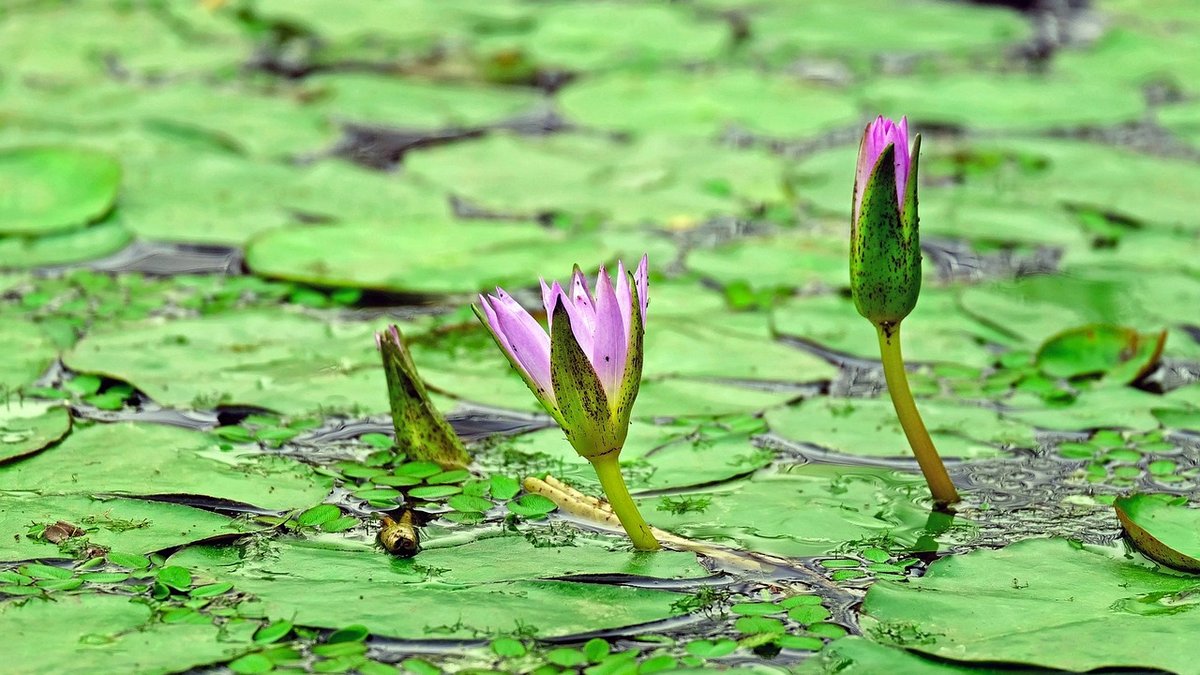
Most pond advice assumes full sun, and it is true that a baking, south-facing puddle will give you more flowering water lilies and a few more dazzling dragonflies. But a corner that sees only two or three hours of sun a day — or none at all — can be every bit as rich in wildlife, and far easier to look after. Less light means less algae, slower evaporation and cooler water in a heatwave. Frogs, toads and newts genuinely prefer damp, sheltered conditions, and a pond tucked beside a hedge or a north-facing fence is often the first in the street to be colonised.
The trick is not to fight the shade but to design for it: choose the right spot, shape the edges gently, and plant with natives that evolved in woodland pools and boggy clearings rather than in sun-baked gravel.
Avoid putting the pond directly beneath a deciduous tree. Leaf fall is a nuisance and roots can puncture a liner, so site it a metre or two clear of the canopy. Check, too, that nothing drains into it — a path used with weedkiller or a driveway washing off oil will poison the water very quickly.
Size matters less than shape. Even a pond of 1.5 metres by 1 metre is a genuine habitat, though bigger volumes stay balanced with less fuss. Dig to around 60–75cm at the deepest point, with a shelf 10–20cm deep and 20–30cm wide running round part of the edge for marginal plants and for creatures to clamber in and out.
Above all, avoid vertical sides. Leave at least one gentle slope, roughly 20–30 degrees, acting as a beach. A frog, a hedgehog or a thirsty blackbird that falls in must be able to walk out, and steep butyl walls give them nothing to grip. Set the finished water level a few centimetres below the surrounding soil so nothing pours in during heavy rain.
Line with butyl rubber over a protective fleece and a soft underlay of sand or old carpet, or use a preformed liner for a small pond. Hide the liner edge under turf or stones so sunlight cannot degrade it. Fill from a water butt rather than a tap: tap water is rich in nutrients and will feed the algae you are trying to avoid.
Aim to cover no more than a third of the surface with foliage, so light and oxygen can still reach the water. Shade-tolerant natives do the job beautifully, and it is worth adding a handful of oxygenators such as hornwort, water starwort or water moss — hornwort simply floats, so there is no planting to do.
Leave out yellow flag iris, water lilies and purple loosestrife; they need sun and will only sulk or spread. Never introduce floating pennywort, parrot's feather or New Zealand pygmyweed, and never tip out aquarium or pond-centre plants into the wild — these are among our worst invasive species.
The ground around the pond is where a shady site really comes into its own. Ferns — lady fern, hart's tongue, soft shield — give structure and shelter, while bugle, primroses, wood cranesbill and foxgloves bring nectar into the dappled light. Native sedges such as Carex remota knit the waterline together, and meadowsweet will cope with a half-shaded damp patch and smell wonderful in July.
Resist the urge to tidy every leaf. A thick litter of fallen foliage around the margins keeps the soil cool and damp, shelters beetles and slugs (frog food), and gives amphibians somewhere to hide between showers.
Keep garden chemicals well away from the pond and its surrounds, and never use slug pellets near the water.
Shaded ponds are low-maintenance by nature, but autumn leaves are the one job worth doing. Stretch netting over the water from October to December, or skim regularly with a long-handled net, and compost what you collect. Leave the silt and a few leaves on the bottom — frogs and newts hibernate there — and never empty and scrub a wildlife pond; you would be destroying the entire food web.
Top up in dry spells with rainwater from a butt, and pull out excess blanketweed or duckweed by twisting it around a cane in spring. Then step back. Within a year you should have frogspawn, and within two, a pond that hums quietly in the shade while the sunny ones bake.

Hi, my name is Anthony kuber. I am artist and fashion designer.
I love to travel and writing blogging.
Your email address will not be published. Required fields are marked *
Software Developer & Writer
Hey, I'm Diva, a developer and writer blending code and creativity. I'm driven by a deep curiosity and a relentless pursuit of excellence. Join me as I craft digital solutions and captivating stories.


